|
|
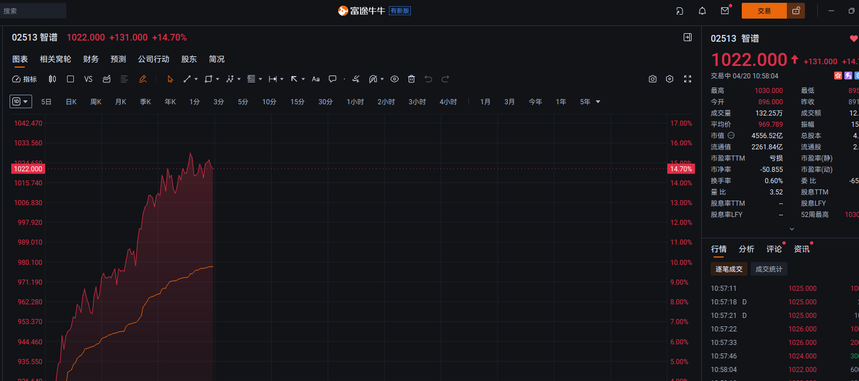
Up over 770% in three months, Zhipu(02513.HK)becomes the second AI stock on the Hong Kong market to hit the HK$1,000 mark this year: bubble or the future?Time:2026-04-20 ZC Asia has learnt that following its intraday breach of the HK$1,000 mark on 13 April, Zhipu (02513.HK), a leading domestic AI firm, continued to strengthen on 20 April, rising by over 14% at one point. As of 10:31 am, the share price stood at HK$1,022, up 14.7%, setting a new all-time high and becoming the second AI company on the Hong Kong stock market this year to join the HK$1,000 club, following MINIMAX-W (00100.HK). Since its listing on the Hong Kong Stock Exchange on 8 January at an issue price of HK$116.2, Zhipu has seen its share price surge by over 770% in just over three months, with its total market capitalisation exceeding HK$450 billion, surpassing established internet giants such as JD.com and Baidu.
However, whilst the share price has continued its meteoric rise, market controversy regarding a high-valuation bubble has intensified.
Revenue Doubles, Losses Widen in Tandem
According to Zhipu’s 2025 annual report, the company achieved annual revenue of 724 million yuan, representing a year-on-year increase of 131.85% and maintaining a trend of doubling growth for three consecutive years. Revenue in the second half of the year stood at 533 million yuan, marking a quarter-on-quarter surge of approximately 180% compared to the first half, with clear signs of accelerating commercialisation.
On the technical front, the company has continued to iterate on its GLM series of models, retaining its position as the world’s top open-source model in major international benchmarks. Internally, the company has derived a concise formula: “AGI commercial value = upper bound of intelligence × scale of token consumption”. Following repeated increases in API call prices during the first quarter of 2026, call volumes actually surged significantly, demonstrating a virtuous cycle of “rising volume and price”.
However, behind the impressive revenue figures lies a widening loss. In 2025, the company’s net loss reached as high as 4.718 billion yuan, an increase of 59.5% year-on-year. From 2022 to 2025, the company’s cumulative loss over four years amounted to approximately 8.5 billion yuan. Based on the current share price, the company’s price-to-sales ratio remains as high as approximately 590 times, far exceeding that of OpenAI (approximately 65 times) and Anthropic (approximately 27 times), and also higher than that of MiniMax (approximately 300 times), another large-model stock listed on the Hong Kong Stock Exchange.
Computing Power Dependency and Customer Concentration
Market concerns regarding Zhipu extend far beyond valuation levels. Financial reports show that for every 1 yuan of revenue, the company spends approximately 8 yuan on R&D. In 2025, R&D expenditure totalled 3.18 billion yuan, of which computing power costs accounted for approximately 2.283 billion yuan—a staggering 71.8%—making it the primary factor eroding profits. More critically, the company lacks its own supercomputing centre and relies almost entirely on externally procured computing power; this ‘fundamental weakness’ is particularly pronounced against a backdrop of intensifying industry competition.
In terms of gross margin, the gross margin of the company’s core on-premises deployment business fell from 66% in 2024 to 48.8% in 2025, whilst the overall gross margin stood at just 41%. Cash flow pressures are equally significant – as of now, the company’s cash reserves are sufficient to sustain operations for only approximately one to two years, meaning long-term development will rely on continuous external financing.
There are also underlying concerns regarding revenue quality. Revenue for 2025 stood at 724 million yuan, with accounts receivable as high as 699 million yuan; accounts receivable accounted for approximately 96.5% of revenue, indicating clear signs of credit sales. The customer base is highly concentrated, with the top five clients contributing nearly 60% of revenue, resulting in weak risk resilience. The business model focuses solely on the B2B market, lacking support from consumer-end traffic; clients are highly price-sensitive, switching costs are low, and customer retention is insufficient.
Institutional Optimism vs Market Scepticism
Despite ongoing controversy, several brokerages have maintained positive ratings. Cinda Securities noted that the company’s ARR is accelerating, with high-quality tokens seeing both volume and price rise, whilst the commercialisation of its API platform has entered a new phase. Guosen Securities initiated coverage with an “Outperform” rating. Soochow Securities forecasts that Zhipu’s revenue for 2026–2028 will be RMB 3 billion, RMB 7.8 billion and RMB 21 billion respectively. It believes the company possesses strong technological barriers and a clear commercialisation path, and has assigned a “Buy” rating.
Industry experts point out that, as a leading domestic AI large-model enterprise, Zhipu’s technological innovation and commercialisation efforts are commendable; however, its current share price and valuation have already significantly over-discounted future growth expectations. Although the AI industry holds vast prospects, it remains in its early stages of development, with high levels of uncertainty surrounding technological iteration, profit models and market competition. Currently, nearly 60 large-scale model products have been launched domestically, resulting in severe homogenisation within the sector. Full-stack tech giants such as Alibaba Cloud, Tencent Cloud, ByteDance and Baidu are continuously squeezing market space by leveraging their advantages in capital, computing power and ecosystem.
With the explosive demand for AI computing power, Hong Kong-listed sectors such as chips and optical communications have strengthened in tandem, forming a dual-track rally pattern of ‘AI models + infrastructure’. The market is shifting from being ‘traffic dividend-driven’ to ‘technology innovation-driven’, but investors must also be wary of the risks of high-valuation bubbles and rationally seize structural opportunities within these high-growth sectors.
Disclaimer: The content herein is for reference only and does not constitute any form of investment advice. Should any information contained herein prove inaccurate, incomplete, or potentially misleading, please refer to the company's official announcements. Market risks exist; investment requires caution. |