|
|
Tianxing Medical, China's Leading Sports Medicine Provider, Files for Hong Kong IPO: Core Products See Major Price Cuts as Founder Exits with Nearly RMB 500 Million Cash-OutTime:2026-03-04 ZC Asia has learned that Tianxing Medical, which previously failed in its 2023 attempt to list on the STAR Market, has recently shifted its focus to the Hong Kong stock market and is making another push for an IPO. On March 3, Hong Kong Stock Exchange filings revealed that China's largest domestic sports medicine equipment provider has formally submitted its listing application, with CITIC Securities and CCB International serving as joint sponsors.
According to CIC(灼識諮詢) data, Tianxing Medical ranks fourth in China's sports medicine equipment market by 2024 revenue, holding approximately 6.5% market share in China's sports medicine implants and devices sector—topping all domestic brands. Founded in July 2017 by Dong Wenxing, Nie Hongxin, and Chen Hao, the company specializes in clinical solutions for sports medicine.
As of the latest practicable date, Tianxing Medical has developed a portfolio of 62 products encompassing implants, active devices, related medical consumables and surgical instruments, as well as regenerative repair products. Notably, the company holds 27 Class III medical device certificates and 24 Class II medical device certificates, making it the enterprise with the largest number of certifications in China's sports medicine industry. Additionally, the company has obtained over 200 medical device regulatory approvals and registration certificates in Europe, Southeast Asia, the Middle East, and Latin America.
In terms of market penetration, as of December 31, 2024, the company's products have been adopted by over 3,000 hospitals, including more than 1,000 tertiary hospitals. Cumulative product sales exceeded 1.8 million units as of September 30, 2025.
Performance continues to grow, but implant prices have declined significantly due to centralized procurement.
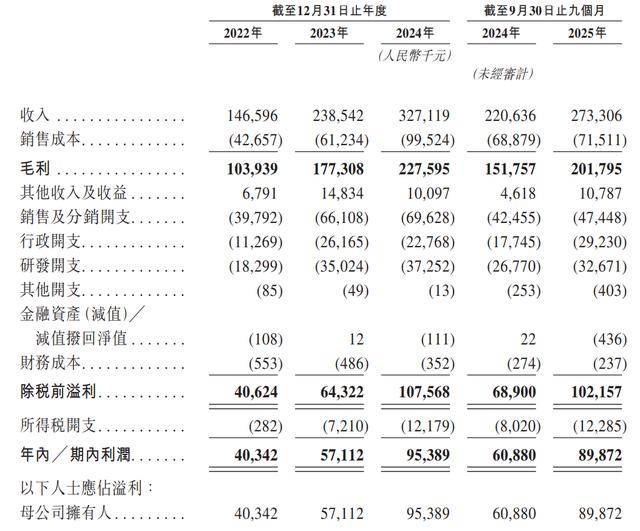
Financial data indicates that Tianxing Medical has maintained steady revenue growth in recent years. For the years 2022, 2023, 2024, and the nine months ended September 30, 2025, the company's revenues were RMB 147 million, RMB 239 million, RMB 327 million, and RMB 273 million, respectively. Profits for these periods were RMB 40.34 million, RMB 57.11 million, RMB 95.39 million, and RMB 89.87 million, respectively. (Image source: Company prospectus)
However, the company's revenue structure is highly dependent on implant products. From 2022 to 2024, these products accounted for 79.8%, 78.2%, and 76.4% of total revenue, respectively. In the first three quarters of 2025, they still constituted a significant 77.6%, remaining the primary revenue source. Surgical equipment and related consumables contributed approximately 20% of revenue, while other products made minimal contributions.
Alarming signs indicate that the company's core products face significant pricing pressure amid the advancement of China's volume-based procurement policy. The prospectus reveals that since the policy's implementation across all mainland provinces in 2024, 14 out of the company's 19 implant products have been included in the volume-based procurement program. Consequently, the average selling price (ASP) of implants declined from RMB 735.8 in 2022 to RMB 711.9 in 2023, plunging further to RMB 446.3 in 2024 before slightly rebounding to RMB 448.6 in the first three quarters of 2025. The price decline directly led to the company's gross profit margin falling from 79.0% in 2023 to 72.4% in 2024.
Increased Customer Concentration, Rising Inventory Levels
Tianxing Medical primarily relies on a distribution model for product sales. As of September 30, 2025, the company's domestic distribution network comprised over 200 distributors across mainland China. However, customer concentration continued to rise during the reporting period, with revenue from the top five customers accounting for 31.9%, 53.1%, 57.7%, and 58.5% of total revenue, respectively. Revenue from the largest customer increased from 7.7% in 2022 to 19.4% in the first three quarters of 2025.
Concurrently, the company's inventory levels have risen year after year. Inventory amounts recorded at the end of each reporting period were RMB 27.1 million, RMB 39.3 million, RMB 57.2 million, and RMB 70.6 million, respectively. The company acknowledged that overestimating market demand could lead to excess inventory, thereby increasing storage and disposal costs. It could also heighten the risk of product obsolescence or necessitate write-offs, adversely affecting operating performance.
Founder Exits with Nearly 500 Million Yuan Cash-Out; Control Changes Hands Multiple Times
Regarding equity structure, Tianxing Medical underwent significant changes. At its inception, Dong Wenxing, Nie Hongxin, and Chen Hao held stakes of 35%, 55%, and 10% respectively, with Nie Hongxin as the actual controller. In October 2019, Chen Hao transferred his 10% stake to Nie Hongxin and completely exited the company. Subsequently, Nie Hongxin began gradually reducing his holdings. According to publicly available data, Nie Hongxin transferred shares in Tianxing Medical multiple times through entities under his control, such as Anjilian'en and Anjijintian, realizing approximately RMB 490 million in cash proceeds. His shareholding ratio has decreased from the initial 55% to 4.9%. Meanwhile, Dong Wenxing also transferred part of his equity through Tianjin Yunkang, a holding platform under his control. By the time of the STAR Market listing application, the company's actual controller had changed from Nie Hongxin to Dong Wenxing, who collectively controlled 41.47% of the company's voting rights.
Overseas Expansion Faces Multiple Uncertainties
Tianxing Medical is currently expanding into European, Middle Eastern, and Southeast Asian markets. However, the company's prospectus cautions that future operations may be impacted by evolving international economic, regulatory, social, and political conditions. Tariffs, geopolitical tensions, or new international trade regulations could prompt local governments to retaliate through regulatory measures, tariffs, and other import/export restrictions. The company may also face heightened taxation, tariffs, and trade barriers due to trade disputes and shifts in foreign policies.
For this Hong Kong listing, the company plans to allocate raised funds toward expanding production capacity, supporting R&D efforts, commercialization and marketing activities, as well as working capital and general corporate purposes. Amidst multiple challenges—including pricing pressures on core products, founder cash-outs, and increasing customer concentration—Tianxing Medical's ability to successfully list in Hong Kong remains to be tested by the market. Disclaimer: The content herein is for reference only and does not constitute any form of investment advice. Should any information contained herein prove inaccurate, incomplete, or potentially misleading, please refer to the company's official announcements. Market risks exist; investment requires caution. |