|
|
Dier Laser (300776.SZ) Aims for Hong Kong Listing: 80% Market Share Fails to Mask Performance Concerns, New Business Generates Less Than 10 Million in Revenue Over Three YearsTime:2026-04-23 ZC Asia has learnt that, nearly six years after listing on the ChiNext board of the A-share market, Dier Laser, a leading manufacturer of photovoltaic laser equipment, has recently formally submitted an application to the Hong Kong Stock Exchange, seeking an ‘A+H’ dual listing. China International Capital Corporation (CICC) is acting as the sole sponsor.
This “hidden champion”, which commands over 80 per cent of the global market share for photovoltaic cell laser processing equipment, has outlined an ambitious blueprint in its prospectus for expansion into sectors such as advanced semiconductor packaging and next-generation displays. However, a review of its financial data reveals that this industry leader is facing multiple pressures, including slowing growth in its traditional core business, lengthening payment cycles from downstream clients, and the protracted commercialisation of its new business ventures.
Market share exceeds 80%, but growth is showing signs of fatigue
The prospectus reveals that, based on revenue from photovoltaic cell laser processing equipment in 2025, the company’s global market share stands at 80.4%, effectively establishing a monopoly.
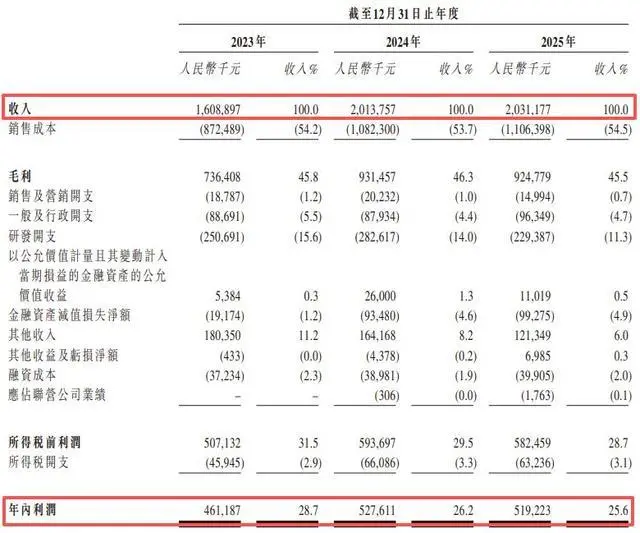
However, such a high market share also implies that the company is approaching the growth ‘ceiling’ within the photovoltaic sector. Financial data shows that from 2023 to 2025, Dier Laser’s operating revenue grew from 1.609 billion yuan to 2.031 billion yuan, but the growth rate slowed significantly—with revenue growth in 2025 falling below 1% year-on-year, whilst net profit for the year stood at approximately 519 million yuan, a 1.59% decrease from the 528 million yuan recorded in 2024. The net profit margin also showed a year-on-year decline, falling from 28.7% in 2023 to 25.6% in 2025. (Source: Company prospectus)
The revenue structure is highly concentrated. In 2025, laser equipment for photovoltaic cells and modules contributed approximately 2.004 billion yuan in revenue, accounting for 98.6% of total revenue. Meanwhile, the advanced semiconductor packaging and new display laser equipment business, in which the company had placed high hopes, generated revenue of only 354,000 yuan in 2025, representing a mere 0.1% of the total. Throughout the reporting period, this emerging business recognised cumulative revenue of only approximately 8.124 million yuan.
Contract liabilities shrank by 547 million yuan over two years, whilst accounts receivable exceeded 1 billion yuan As of the end of 2025, Dier Laser’s contract liabilities had fallen to 1.413 billion yuan, compared to 1.96 billion yuan at the end of 2023. Over the two-year period, the book value of contract liabilities decreased by a cumulative 547 million yuan. The company explained that this was primarily due to advance payments being recognised as revenue upon acceptance of the equipment.
In contrast, the “goods in transit” component of inventory remained at a high level. As of the end of 2025, the book value of goods in transit still stood at 1.254 billion yuan. This indicates that although a large volume of equipment has been dispatched to customer sites, final revenue recognition has been delayed due to the production line progress of downstream photovoltaic enterprises or prolonged acceptance procedures, resulting in significant pressure from tied-up capital.
The expansion of trade receivables is even more evident. By the end of 2025, the company’s net trade receivables had risen to 1.085 billion yuan, compared with 739 million yuan at the end of 2023. It is worth noting that whilst revenue grew by only 0.8% year-on-year in 2025, net trade receivables increased by 21.25% year-on-year. The days sales outstanding (DSO) for trade receivables jumped sharply from 139 days in 2023 to 178 days in 2025, indicating a marked slowdown in customer payment cycles.
Consequently, a significant divergence emerged between the company’s operating cash flow and net profit. In 2025, Dier Laser’s net cash flow from operating activities stood at approximately 111 million yuan, leaving a shortfall of around 400 million yuan compared to the period’s profit of 519 million yuan. In 2024, the company even recorded a net cash outflow from operating activities of approximately RMB 201 million.
Reliance on Major Clients and Overlapping Roles as Customer and Supplier, with a Sharp Rise in Bad Debt Provisions
The prospectus reveals that in 2025, revenue from the largest client, Client E, alone reached RMB 517 million, accounting for 25.5% of the company’s total revenue; the second-largest client, Client F, contributed RMB 360 million, representing 17.7%. This implies that over 40% of revenue is concentrated in the hands of just two photovoltaic enterprises.
More notably, several of the company’s top five clients—including Clients A, B, C, E and F—are simultaneously its suppliers. The company explains that this phenomenon of “client-supplier overlap” primarily stems from the need to purchase samples from suppliers for equipment testing and calibration, the requirement to build its own photovoltaic power stations, and the recycling of clients’ old equipment for upgrading and refurbishment.
With the cyclical downturn in the downstream photovoltaic industry and several listed companies shifting from profit to loss, Dier Laser’s credit risk has risen significantly. The company’s net impairment losses on financial assets surged from 19.174 million yuan in 2023 to 99.275 million yuan in 2025, representing a more than fourfold increase over two years.
Slow commercialisation of new businesses; R&D material costs plummet by nearly 60%
In its prospectus, Dier Laser listed “anchoring itself in cutting-edge semiconductor directions to forge a second growth curve” as a key strategy; however, the commercialisation process for these related businesses has been exceptionally slow.
In 2023, the advanced semiconductor packaging and new display laser equipment division generated revenue of approximately 7.77 million yuan; revenue dropped to zero in 2024 and amounted to only 354,000 yuan in 2025. The company explained that the reason for the zero revenue in 2024 was that “no equipment was accepted during the year, and therefore no revenue was recognised”.
Meanwhile, R&D expenditure contracted significantly in 2025, falling by 18.8% year-on-year to approximately 229 million yuan. Within this, “material costs” within R&D expenditure dropped sharply from 54.66 million yuan in 2024 to 22.13 million yuan in 2025, a decrease of 59.5%. Furthermore, share-based payment expenses included in R&D expenditure recorded a negative value of RMB 3.11 million in 2025.
The market generally believes that the semiconductor equipment sector involves higher customer certification thresholds and longer validation cycles. Whether Dier Laser can replicate its success in the photovoltaic sector within niche segments such as TGV laser micro-drilling, PCB drilling and Micro LED mass transfer remains to be seen.
Disclaimer: The content herein is for reference only and does not constitute any form of investment advice. Should any information contained herein prove inaccurate, incomplete, or potentially misleading, please refer to the company's official announcements. Market risks exist; investment requires caution. |