|
|
“First State-Owned New Energy Stock” Meets a Cool Reception on Debut:VOYAH (07489.HK) Drops Over 14% During TradingTime:2026-03-19 ZC Asia has learnt that on 19 March,VOYAH (07489.HK), a subsidiary of Dongfeng Group, officially listed on the Hong Kong Stock Exchange, becoming the “first state-owned high-end new energy stock”.
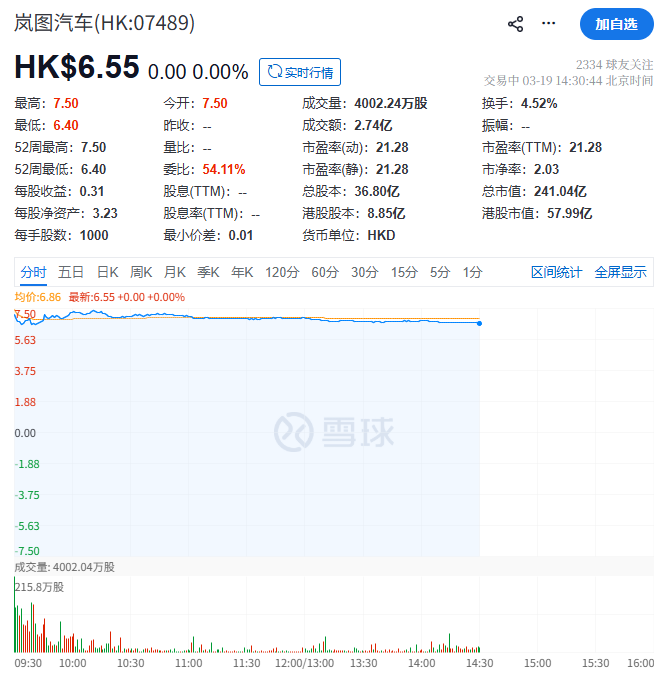
(Image source: Snowball) Market data shows that LT Auto opened at HK$7.50 per share today, but subsequently fell rapidly, hitting an intraday low of HK$6.40, a drop of over 14%. At the midday close, the share price hovered around HK$6.98, with a generally weak performance throughout the day.
It is worth noting that this opening price is significantly lower than the implied valuation previously calculated by the market based on the privatisation plan of its parent company, Dongfeng Motor Group (00489.HK). According to the original plan, shareholders accepting the privatisation would receive HK$6.88 in cash plus 0.355 shares of LT Auto per share; based on this, the implied value of LT Auto was approximately HK$11.18 per share. The opening price represents a clear discount compared to this figure.
The listing was conducted via an introduction, meaning the company did not raise new capital through an IPO; the primary objective was to establish a trading platform in overseas capital markets, paving the way for future financing activities.
Return to Profitability: Sales and R&D Data Draw Attention
In terms of financial performance, LT Auto recorded revenue of RMB 34.9 billion for the full year of 2025, with a compound annual growth rate of 79% over the past four years. On the profitability front, the company’s net profit attributable to shareholders reached RMB 1.02 billion, marking a turnaround from loss to profit. However, the financial report details also reveal that government-related subsidies of approximately RMB 1.08 billion were included in that year’s figures, suggesting that the company’s core business profitability still needs to withstand further market scrutiny.
In terms of sales structure, the VOYAH brand currently exhibits a high degree of reliance on a single model. Data indicates that the MPV model ‘Dreamer’ accounted for over 50% of total sales in 2025, making it the undisputed sales leader. However, entering 2026, the latest passenger vehicle market data shows that Dreamer sales in January stood at 3,574 units, representing a year-on-year decline, which places some pressure on the achievement of this year’s sales targets.
In terms of R&D investment, the prospectus reveals that from 2022 to 2025, the proportion of R&D expenditure to revenue for VOYAH Automobile stood at 5.5%, 4.7%, 4.2% and 3.9% respectively, showing a downward trend year on year. Against the backdrop of competition in the new energy vehicle sector increasingly focusing on intelligent technology, this shift in figures has also drawn the attention of some market analysts.
Intensive New Product Planning: Seeking Valuation Support and Structural Optimisation
Faced with the challenges of reliance on a single model and intensifying market competition, LT Auto has outlined a clear product expansion roadmap in its prospectus. The company plans to launch several new models in 2026, including the Taishan Ultra, Taishan X8, FE and Zhufeng, with the aim of covering a broader range of market segments. Among these, the “Taishan X8”, positioned as an 8-series SUV, made its debut at today’s listing event. Equipped with four LiDAR sensors and a new-generation HarmonyOS cockpit, it is seen as a key move to optimise the sales structure and open up new growth opportunities.
Furthermore, the company has disclosed that it is actively advancing the research, development and application of Level 3 autonomous driving technology, with a view to enhancing the technological competitiveness of its future products.
Based on the current lower valuation limit of approximately HK$41.3 billion, VOYAH’s static price-to-sales ratio stands at around 1.0 times, placing it in a similar range to some of the other listed new energy vehicle manufacturers. Analysts point out that the successful spin-off listing of VOYAH has established an independent financing platform and a more flexible governance structure for the company. However, long-term recognition of its value by the capital markets will no longer rely solely on the endorsement of its parent company, but will depend more on whether its new products can successfully break through the market, whether its profitability can be substantially improved, and how much actual market share it can capture amidst fierce competition. Disclaimer: The content herein is for reference only and does not constitute any form of investment advice. Should any information contained herein prove inaccurate, incomplete, or potentially misleading, please refer to the company's official announcements. Market risks exist; investment requires caution. |