|
|
Gorelli Submits Second Listing Application to HKEX: Backed by High-Profile Shareholders, Revenue Doubles Over Three Years Yet Accumulates RMB 334 Million LossTime:2026-03-03 ZC Asia has learned that according to a disclosure by the Hong Kong Stock Exchange on March 2, Shanghai Gorelli Software Co., Ltd. (hereinafter referred to as “Gorelli”) has submitted a listing application to the Main Board of the Hong Kong Stock Exchange. Guotai Haitong Securities and Minyuan Capital are serving as its joint sponsors. This marks the company's second application to the Hong Kong Stock Exchange.
Founded in 2007, Gorelli specializes in providing Intelligent Manufacturing Software Solutions (IMSS) for the broader semiconductor industry. Its solutions span the entire value chain—from production data acquisition, equipment connectivity, and production process management to big data analytics and artificial intelligence applications—serving clients across semiconductors, display panels, printed circuit boards, and photovoltaics.
From a technological breakthrough perspective, Gorelli's development trajectory is highly representative. In 2010, the company first launched an 8-inch semiconductor manufacturing execution system (MES). By early 2023, it successfully delivered a domestically developed CIM system featuring core MES for 12-inch front-end 18nm processes, becoming one of China's first suppliers to achieve breakthroughs in fully automated intelligent manufacturing software solutions for entire 12-inch wafer fabrication plants.
According to Frost & Sullivan data, Gorelli ranks second in China's broader semiconductor IMSS market by 2024 revenue and is the largest domestic supplier in this segment, holding approximately 11.7% of the total market share.
The prospectus reveals that the State-owned Assets Supervision and Administration Commission's (SASAC) SDIC Major Special Project Fund holds a 6.96% stake. China Development Bank's subsidiary CDB Manufacturing holds 5.65%, and SMIC's subsidiary SMIC Haihe Fund also appears on the shareholder list.
Additionally, Shenzhen Qichang under China Merchants Capital holds 4.14%, Shenzhen Chenxin under State-owned Capital Venture Capital Fund holds 4.14%, and Shenzhen Investment Holding under Shenzhen State-owned Assets holds 2.07%. This shareholder structure not only provides capital support but also opens up possibilities for industrial synergy. It is reported that Gorelli completed its Series D financing round in October 2023, achieving a post-investment valuation of RMB 3.54 billion.
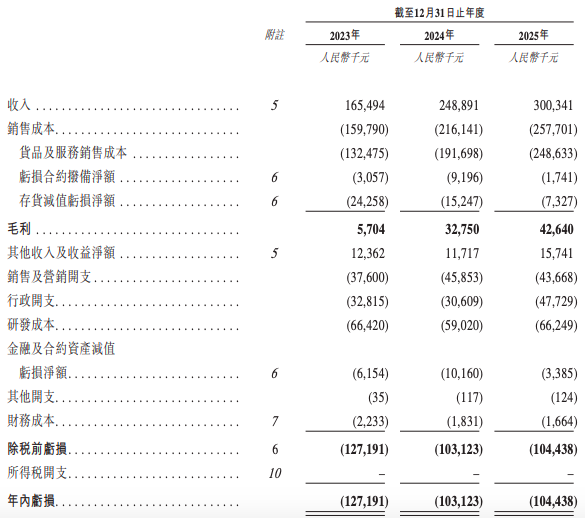
From a revenue perspective, Gorelli's growth momentum is undeniably impressive. The prospectus shows that from 2023 to 2025 (the reporting period), the company's revenues reached RMB 165 million, RMB 249 million, and RMB 300 million respectively, with a compound annual growth rate (CAGR) of 34.7%.
(Image source: Company prospectus)
However, during the reporting period, the company recorded net losses of RMB -127 million, -103 million, and -104 million, respectively, accumulating total losses of RMB 334 million over three years. Gorelli candidly stated in its prospectus, “We may not achieve or subsequently maintain profitability in the near future.”
Furthermore, the company's overall gross profit margin stood at 3.4%, 13.2%, and 14.2% during the reporting period. Although it rebounded after 2024, it remained at a low level. More alarmingly, the gross profit margin of its core CIM software solutions plummeted in 2025, dropping sharply from 23.1% in 2024 to 15.0%.
More concerning than the losses is the cash flow situation. During the reporting period, the net cash used in operating activities was -116 million yuan, -143 million yuan, and -113 million yuan, respectively, resulting in a cumulative cash outflow exceeding 370 million yuan over three years. This indicates that despite revenue growth, the company consistently failed to generate positive operating cash flow, relying heavily on external financing for daily operations and expansion.
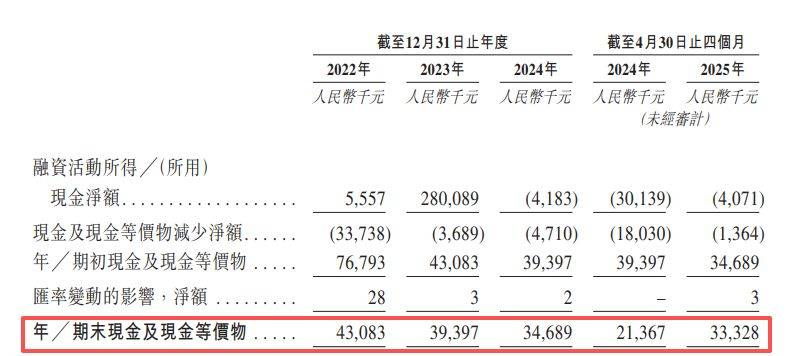
By the end of 2025, the company's cash and cash equivalents balance stood at merely RMB 33.328 million. According to projections in the prospectus, based on the average monthly cash burn rate of RMB 12.3 million in 2024, the current cash reserves would only sustain financial viability for approximately 33.5 months.
(Image source: Company prospectus)
Accompanying revenue growth is an increasingly bloated accounts receivable. During the reporting period, the company's trade accounts receivable and notes receivable surged from RMB 117 million at the end of 2023 to RMB 208 million by the end of 2025, with trade receivables turnover days reaching 197 days (2025). As of January 31, 2026, only approximately 5.0% of the trade receivables and notes receivable as of the end of 2025 had been settled.
Customer concentration represents another significant concern. During the reporting period, revenue from the top five customers accounted for 54.2%, 46.7%, and 23.1% respectively. Although this proportion decreased in 2025, the company acknowledged that “in the foreseeable future, business and financial performance may continue to depend on sales to a relatively small number of customers.” The prospectus also noted that the company typically does not enter into long-term contracts with major customers, with business primarily conducted on a project-by-project basis.
Notably, the prospectus discloses compliance risks. During the reporting period, the company's shortfalls in social insurance and housing fund contributions amounted to approximately RMB 12.1 million, RMB 10.5 million, and RMB 14 million respectively, totaling about RMB 36.6 million. This may pose a compliance challenge during the company's listing process.
Additionally, the company faces overlapping client-supplier relationships. During the reporting period, Client Group A and Client Group C simultaneously served as both clients and suppliers. This “buyer-seller hybrid” business model has raised market questions regarding the authenticity of transactions and the fairness of pricing.
For secondary market investors, the key question remains: what valuation is appropriate for a company exhibiting high revenue growth yet persistent losses, volatile gross margins, and emerging compliance risks? This is undoubtedly a critical issue warranting thorough examination.
Disclaimer: The content herein is for reference only and does not constitute any form of investment advice. Should any information contained herein prove inaccurate, incomplete, or potentially misleading, please refer to the company's official announcements. Market risks exist; investment requires caution. |