|
|
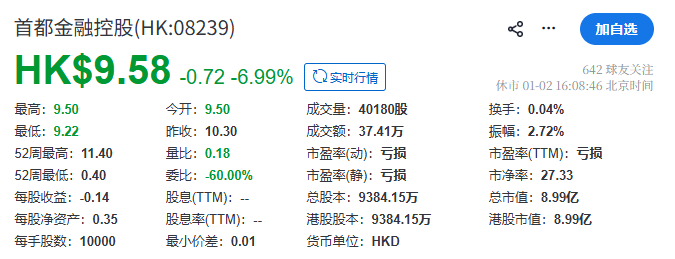
Capital Financial Holdings (08239.HK) plunged nearly 7% in a single day amid extremely thin trading volumes. What underlying concerns lie behind this?Time:2026-01-04 ZC Asia has learnt that on the first trading day of 2026 (2 January), Capital Financial Holdings (08239.HK) failed to sustain its year-end upward momentum, experiencing a significant correction. At the close of 2 January, the stock stood at HK$9.58, down HK$0.72 or 6.99% from the previous session, with a daily turnover of merely HK$374,100. (Image source: Snowball) Market data indicates the stock opened lower at HK$9.50 that day, with its highest point remaining at HK$9.50. It dipped to a low of HK$9.22, exhibiting a trading range of 2.72%. Overall, it followed a weak pattern of opening lower and declining throughout the session. Although the bid-ask ratio indicated a 60% advantage for buy orders in terms of order volume, trading activity remained extremely thin. The volume ratio stood at a mere 0.18, with turnover rate dropping to 0.04%.
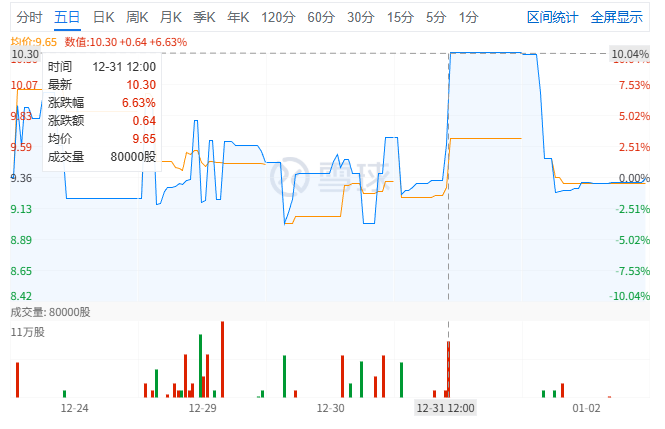
This contrasts sharply with the previous trading day (31 December 2025), which saw a late-session rally. After surging over 6% on the final trading day of the year, the stock nearly erased all gains on the first trading day of the new year, exhibiting clear swing trading characteristics. Following this decline, the share price has retreated approximately 16% from its 52-week high of HK$11.40. (Image source: Snowball)
Fundamental data reveals no improvement in the company's financial performance. Earnings per share stand at -HK$0.14, with net asset value per share merely HK$0.35. Yet its price-to-book ratio soars to 27.33 times, indicating a severe divergence between valuation and asset value. All price-to-earnings metrics reflect losses, further confirming the lack of earnings support for its share price volatility.
Underlying this sharp volatility lies the company's deep-rooted structural risks. The most critical issue is the extreme concentration of share ownership. According to the Hong Kong Securities and Futures Commission's public warning in September 2025, over 90% of the company's shares are held by its top 25 shareholders. This structure results in an extremely low proportion of shares circulating in the open market, directly reflected in the abnormally low trading volumes over two consecutive days (turnover rates of 0.16% and 0.04% respectively) and the meagre trading value.
This liquidity drought has spawned another peculiarity: a substantial bid-ask spread. During the previous trading session's real-time quotes, the gap between the best bid and ask prices exceeded 14% – a condition readily emerging during thin trading. This implies ordinary investors face prohibitively high instantaneous transaction costs and the risk of failed trades when attempting to buy or sell shares.
Capital Financial Holdings' recent trajectory epitomises the behaviour of a ‘shell stock’ under conditions of extreme ownership concentration. Its share price fluctuations have become decoupled from the company's fundamentals (persistent losses, unclear business operations), being purely driven by the trading activities of a small number of holders. This makes it highly susceptible to sharp, short-term surges and crashes.
Disclaimer: The content herein is for reference only and does not constitute any form of investment advice. Should any information contained herein prove inaccurate, incomplete, or potentially misleading, please refer to the company's official announcements. Market risks exist; investment requires caution. |